






Every spring, the same scene repeats. Thousands of homeowners prepare their swimming pools for the summer season, and during cleaning or maintenance tasks, they discover that the passage of time has left its mark. The lining has lost uniformity, superficial cracks appear, colors have faded, the edge shows signs of wear, or the overall appearance conveys a sense of age that clashes with the rest of the home.
In most cases, these pools remain completely functional from a structural point of view. Their shell maintains stability, the hydraulic system continues to operate, and the construction preserves the necessary conditions to continue providing service for many years. The problem lies not in the structure, but in the natural aging of finishes and materials permanently exposed to water, ultraviolet radiation, chemicals, and temperature changes.
This reality is profoundly changing the way renovations are approached in outdoor spaces. Just a few years ago, an aged pool was almost automatically associated with a partial or complete demolition to carry out a new construction. Today, the evolution of technical materials, coating systems, and rehabilitation solutions allows for the complete recovery of its functionality and appearance without the need to start from scratch.
The market is responding to this transformation. More and more homeowners are prioritizing actions capable of renovating existing pools, extending their useful life, and adapting them to current trends with a more efficient investment. This evolution responds to both economic criteria and a greater awareness of resource utilization, reduction of construction waste, and optimization of execution times.
Rehabilitation has ceased to be a temporary solution and has become a strategy for asset improvement. It involves intervening only where it is truly necessary, preserving everything that maintains its performance and acting on the elements that affect the aesthetics, comfort, or durability of the ensemble.
This trend gains even more momentum as summer approaches. Homeowners seek quick, clean, and plannable projects that allow them to enjoy the pool during the bathing season, avoiding long periods of inactivity. In this context, rehabilitation offers a particularly effective response.
Behind this paradigm shift are several factors explaining its growth. The cost difference compared to complete demolition, the reduction in execution times, the utilization of the existing structure, the possibility of completely updating the pool’s image, and the increase in value it adds to the home are some of the reasons driving this trend in the sector.
Demolition Costs vs. Rehabilitation
From a technical and economic standpoint, one of the strongest arguments in favor of rehabilitation lies in investment optimization.
Demolishing a pool involves much more than removing a deteriorated lining. It means carrying out controlled demolition work, managing large volumes of waste, transporting debris, re-preparing the ground, and rebuilding all structural elements. Each of these phases significantly increases the final cost of the intervention.
When the structure maintains adequate conditions of stability and watertightness, many of these tasks become unnecessary. The intervention focuses on renovating surfaces, localized repair of minor defects, and application of new coating systems adapted to current demands.

This approach allows the investment to be directed towards improving the pool’s performance and appearance, avoiding expenses related to actions that would technically be unnecessary. The result is a much more economically efficient renovation, capable of offering benefits similar to a new construction pool.
Reduction in Construction Times
The schedule is one of the factors that most influences any pool renovation.
New construction projects require numerous successive phases: demolition, excavation, substrate preparation, structural execution, installations, waterproofing, coatings, and final finishes. All of this implies weeks, or even months, of work before the pool can be put back into operation.
Rehabilitation completely modifies this scenario.
By preserving the existing shell, most of the intervention focuses on substrate preparation and the application of new technical systems capable of restoring original performance. This considerably reduces the duration of the work and facilitates a much tighter schedule.
For owners of private homes, residential communities, hotels, or tourist complexes, this speed is a decisive advantage. It reduces inconvenience, minimizes the occupation of the work area, and allows the pool to be available again in a much shorter timeframe, which is especially important when the project is planned just before the summer season.
Utilization of Existing Structure
One of the most important principles of modern rehabilitation is to preserve what continues to function correctly.
In many pools built two or three decades ago, the structure maintains excellent mechanical performance. Problems mainly appear in aged linings, deteriorated joints, loss of color, or minor surface defects resulting from continuous use.
From a technical perspective, replacing a structure that is still perfectly valid is an inefficient action. Rehabilitation allows for the utilization of that constructive base, reinforcement of points that require it, and complete updating of the surface layers.
This approach also aligns with increasingly present sustainability criteria in the construction sector. Reducing waste generation, decreasing the consumption of raw materials, and extending the useful life of existing infrastructure constitute a more responsible way to intervene on the built heritage.

Aesthetic Renovation Without Major Interventions
Design trends evolve rapidly, and pools are no exception.
Finishes that were common twenty years ago now convey an outdated image. Dark tones, excessively glossy linings, or deteriorated surfaces affect the overall perception of the outdoor space, even when the pool continues to function perfectly.
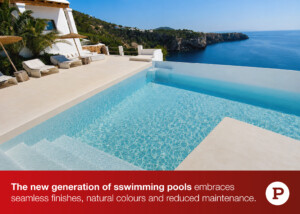
Current rehabilitation solutions allow for a complete aesthetic transformation through high-performance coating systems that reproduce mineral textures, continuous finishes, or natural-looking surfaces.
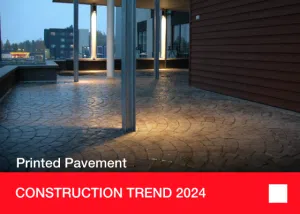
The visual renovation extends to the interior of the pool shell as well as the decks, copings, and perimeter areas, achieving much more harmonious integration with gardens, terraces, and contemporary architecture.
The result is a completely updated pool, capable of offering an appearance equivalent to a new construction without the need for major structural interventions.
Increase in Property Value
The pool has ceased to be a complementary element and has become one of the main enjoyment spaces in the home.
In single-family homes, residential developments, and properties intended for holiday rentals, the state of conservation of the pool directly influences the perception of the property.
An aged installation conveys a sense of lack of maintenance and generates uncertainty about future necessary investments. Conversely, a rehabilitated pool, with modern finishes and high-quality materials, projects an image of care, modernity, and added value.
This improvement positively impacts the commercial attractiveness of the property and can become a differentiating factor in both sales and rental processes, especially in areas where outdoor spaces are a decisive element for buyers.

The Role of Paving in Durable Rehabilitation
The quality of a rehabilitation does not solely depend on repairing the existing substrate. True success lies in selecting construction systems capable of ensuring durability, safety, and aesthetic integration in line with current demands.
Flooring and coatings play a starring role in this process. They are the surface that withstands continuous traffic, constant exposure to water, the action of maintenance products, and the most demanding weather conditions. Both the technical performance and the final appearance of the pool depend on their capabilities.
In this context, the solutions developed by Pavistamp offer a specific response to different rehabilitation needs.
Micropool is an alternative that is particularly suitable for renovating pool tanks through a continuous coating of reduced thickness. Its application allows for a complete update of the existing surface without significantly increasing the system’s thickness, providing high resistance, excellent adhesion, and a uniform, high-quality aesthetic finish.
When the goal is to recreate the appearance of stone materials with a more natural aesthetic, Stone Feel Pool allows for surfaces of great personality, capable of integrating naturally into gardens, terraces, and contemporary outdoor spaces. Its finish adds texture, visual depth, and an elegant image that completely transforms the perception of the pool.
The durability of any renovation also depends on surface protection. In this regard, Hidrocrill plays an essential role as a treatment that contributes to improving impermeability, protecting the coating against external agents, and promoting the long-term preservation of its aesthetic and functional properties.
The combination of technical rehabilitation systems with high-performance flooring is redefining the future of existing pools. Moving away from the traditional idea of completely replacing an aging installation, the sector is advancing towards solutions that leverage the value of the original structure, reduce the economic and environmental impact of the work, and achieve results fully adapted to current demands.
Rehabilitation no longer solely means repair. It means updating, adding value, and extending the lifespan of a pool through technologies and materials that transform an installation with decades of history into a space prepared to remain a protagonist for many more years.